1. No results matched your search.

    Loading...

We use cookies to improve your experience on our website. Please let us know your preferences.

Want to know more? Check out our cookie policy. Click here to manage cookies.

That Hideous Strength

4.0

That Hideous Strength

A Deeper Look at How the West was Lost

Melvin Tinker

4.0

That Hideous Strength

A Deeper Look at How the West was Lost

Melvin Tinker

Quantity

Quantity

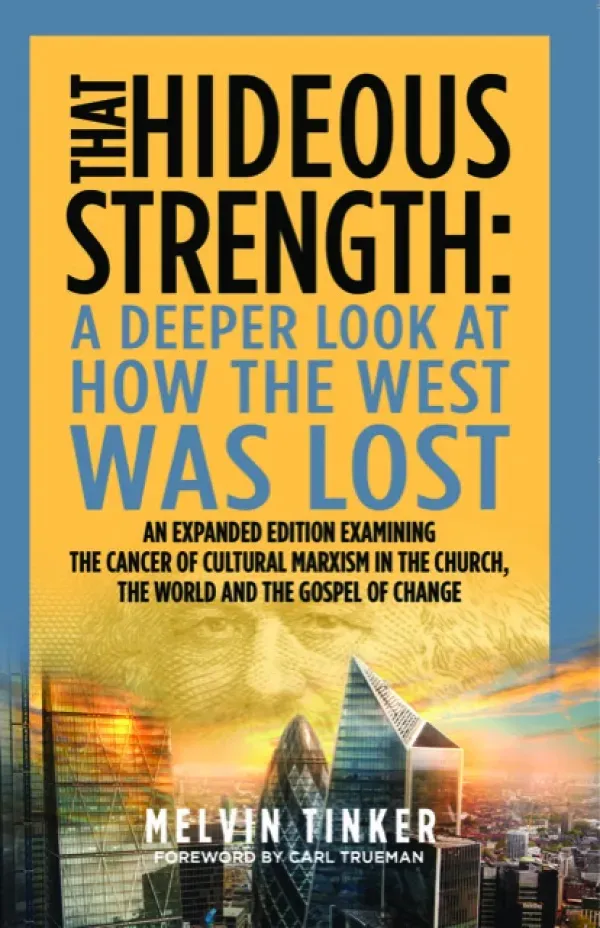
In 2018, Evangelical Press published the original That Hideous Strength: how the West was lost; the book originated as lecture notes author Melvin Tinker prepared for a conference in Jerusalem that year. That edition deliberately had no footnotes and was as compact as possible to appeal to a wide audience. There have been many requests for a footnoted and expanded edition. 

This book is an expanded version of the previous edition—it is about a third larger. The original acted as a ‘primer’ and ‘wakeup call’ to enable Christians especially to try and understand what has been happening in our Western culture for the last few decades due to the influence of what is identified as ‘cultural Marxism’ or ‘Critical Theory’. Many commented that it helped them make connections not seen before; for others, it was an ‘aha moment’, with the light suddenly being switched on as to why much of the Judeo-Christian foundations of the West have been eroded while the Church sleeps. A number of reviewers rightly said it would have been helpful to have had the works quoted referenced and expanded with footnotes that has now been corrected.

As well as unpacking in more detail some of the ideas of cultural Marxists and the way their strategies are being worked out in our society, I have also sought to put more flesh on what the Church’s response might look like by drawing attention to what has been called ‘the Benedict Option’ and developing the concept proposed by Charles Taylor—the ‘social imaginary’. Another significant addition is an outline of the ideas of classical Marxism which places the current concern for cultural Marxism in its proper historical and philosophical context. It also serves to underscore that in many ways the ‘new Marxism’ is a revamping of the ‘old Marxism’ with consequences no less disastrous.

This version includes a Postscript on the rise of 'Black Lives Matter' following the death of George Floyd.

What other are saying about That Hideous Strength:

There are very few books I buy multiple copies of—this is one of them. That Hideous Strength is an essential primer for any Christian in seeking to understand what is going on in society today. The first edition was outstanding but limited because of its size. This new expanded edition overcomes those limitations, without becoming unwieldy or too heavy. This book should be on every church bookstall, and every Christian’s bookshelf. And now I have to go and buy more of the revised edition! — David Robertson, Director of Third Space

  • Title

    That Hideous Strength

  • Author(s)

    Melvin Tinker

  • ISBN

    9781783972944

  • Format

    Paperback

  • Publisher

    Evangelical Press

  • Topic

    Culture

  • Audience

    Adults, Church Leaders

  • Pages

    192

  • Published

    07/01/2020

Melvin Tinker

Melvin Tinker

Melvin Tinker (1955–2021) was Vicar of St John’s Newland, Chairman of Yorkshire Gospel Partnership, Co–director of Northern Training Course and was a leading member of the Anglican group ‘REFORM’. He is a popular author on culture and faith.

See other titles by this author

Overall rating

4.0 based on 1 review

Thought-provoking and motivating

I was glad to receive a review copy of this book and herein leave my comments gratis. The book’s content is compelling. Tinker cites examples of denominations, so-called Christian organizations, and key leaders in global ‘Christianity’ who have left biblical moorings and embraced critical theory. Citing public and private speeches, conversations, and scores of publications, he shows how Western civilization has shifted from a mostly biblical understanding of freedoms—personal, biblical, societal—to disturbingly unbiblical, even totalitarian, viewpoint and policies. Atheist Karl Marx not only promulgated godless ‘solutions’ but advanced them as the lens through which to view the world and humanity, which he re-categorized in terms of oppressors and the oppressed. Though often unrecognized as his legacy, his views are now accepted in much of the world and are intrinsic to the book subtitle’s ‘gospel’ of change. Over time, the proverbial ‘camel’ got its nose into the tent—with now a good deal more of its body inside. Godlessness and deception have infiltrated most Western institutions so as to “subvert society” and thus change its culture (p. 60). Accordingly, “Over the last 60 years or so in the West, there has effectively occurred the death of one culture, rooted in the Judeo-Christian world view, and the rise of another more secular one.” Increasingly larger segments of the global Church have failed to communicate biblical ideals in ways that remain “inwardly compelling” (p. 60), with ‘zero tolerance’ required for ‘conservative’ positions (p. 61). “Destabilizing” language has enabled acceptance of new ‘language’ and the seeming propriety of elites to exert increasingly more power. Tinker’s detailed accounts of this in modern Christendom affirm the validity of his propositions. Especially valuable are quotations from many authors, some of whose writings have impacted me favorably: G. K. Chesterton, C. S. Lewis [of course—Tinker ‘stole’ his title], Rodney Stark, Os Guiness, William Wilberforce, D. A. Carson. (The book is dedicated “To Don and Joy Carson: With gratitude for modeling how to apply the whole of Bible to the whole of life.”) Tinker avers that the silence of some evangelical leaders on major issues and culture as described in the book must end. More than stating problems, he affirms solutions: (1) “a praying people,” (2) “a literate leadership”—both biblical literacy and cultural literacy (pp. 158-159), and (3) “a changed community” (p. 160). The Kingdom of God/Christ is distinct from the kingdom of this world. Living biblically as citizens of God’s Kingdom means we model a culture that is an alternative to the world’s (p. 168). Quoting Os Guiness, Tinker says we must trust God, share and demonstrate the Gospel, follow and live out Christ’s call in all spheres of life, “and then leave the outcome to him” (p. 171). My initial impression of the book wasn't favorable due to myriad errors in punctuation, grammar, and mechanics, plus stylistic quirks. In dozens of places throughout, the word which was incorrectly used instead of that. (They are grammatically different.) Other disturbances are wrong use of possessive pronouns, absence of notation about which Bible translation was used for specific verses, spacing errors, and missing word(s) in Scripture quotations. (These and other oddities account for my 4 rather than 5.) After reading more than a third of the book, I mused that maybe publishing rules in the UK or Denmark (printing site) don’t parallel those found in the USA—which perhaps accounted for some of the ‘errors.’ I'm glad I kept reading until the content captivated my thinking. Though the book is definitely read-worthy, I suggest using a different editor for any future edition.

Carol

Leave a Review

That Hideous Strength

Added to basket!

Always only $4.99 delivery for your whole order!

Especially for you...